

cal bd
Invest Now
cal bd
Invest Now
cal bangladesh
Invest Now

Bucking the trend

Download Report
Download Report

As major global central banks continue a synchronized tightening cycle in 2023, the Bangladesh Bank (BB) has chosen to maintain its accommodative stance, putting a higher priority on fostering economic growth over curbing inflation and reducing pressure on the exchange rate.

The highlights of the announcement are as follows:

  • GDP growth target revised to 6.5%, inflation rate to 7.5%
  • The policy rate increased by 25 bps to 6.0% and the reverse repo rate to 4.25%
  • The lending rate cap remains at 9.0%, except for consumer loans and credit cards. The lending rate cap for consumers’ credit has been relaxed to vary up to 12.0%
  • The floor on the deposit rate has been removed
  • Aiming for a market-based, flexible, and unified exchange rate regime (within a 2% variation) by FY2023.
  • The public sector credit growth target increased by 170 bps to 37.7%
  • The private sector credit growth target remains unchanged at 14.1%

Broad money growth ceiling set at 11.50%, down from 12.1%

CAL’s VIEW:

  • Economic Growth: BB is facing a delicate balancing act between promoting economic growth and containing inflationary and exchange rate pressures. The current monetary policy prioritizes growth. However, acknowledging impending challenges, the central bank has revised the GDP growth rate target to 6.5% in FY2023, which is consistent with our expectations. However, we expect nominal GDP to remain above 14.0% in FY2023 against 12.64% in FY2022.
  • Inflation: Despite the central bank raising its target inflation rate to 7.5%, we believe that the current accommodative monetary policy stance may not be sufficient to bring down inflation from its current levels. The reliance on domestic borrowing is expected to increase in H2FY23, which is reflected in the upward revision of the public sector credit growth target by 170 basis points to 37.7%. Under the current environment, this may accelerate the pace of asset purchases by the central bank stoking further inflation. We expect the upward adjustment to electricity and gas prices, injection of new money, and depreciation of the BDT to push inflation at 9% by the end of Q3FY23.
  • Interest Rate: The lending rate caps that remain in place for most loan categories will keep borrowing rates low for companies facilitating growth and reduce an aggressive build-up of NPLs in the Banking sector. The central bank removed the rate cap for consumer loans and credit cards and provided guidance in the monetary policy that it will remove the remaining lending rate cap under favorable economic conditions. The ongoing lending rate cap will continue to impede the effective transmission of monetary policy throughout the economy.

    We expect the central bank to hike policy rates by an additional 25 basis points by Q3FY23, assuming the Federal Reserve maintains its current projections. We anticipate 364 days T-bills rate to converge towards 9% during the same period.

  • Exchange Rate: The quantitative tightening policy by the US will exert further pressure on the value of the BDT against the USD. The current low level of reserves at BDT 33.63bn suggests that a bigger brunt of such pressures may be absorbed by the BDT rather than utilizing reserves for defense. The central bank’s continued focus on interest rate targeting and increased reliance on domestic borrowing to finance budget deficits will continue to inject new money into the economy putting further pressure on the currency.

    Lower borrowing costs will sustain high credit growth and continue import momentum and motivate speculation on the currency outlook in import and export trade. However, further depreciation in the currency would provide some short-term advantages to export businesses with higher local value addition.

    The exchange rate movement is likely to be largely determined by the scale and pace of monetary tightening. Holding our view of a balanced approach from the BB, we expect the BDT to continue its depreciating trend (expected 8%) and end Q3FY23 at BDT 114.6.

  • Asset Price: A moderate rise in interest rates from current levels and continued injection of liquidity may encourage investors to seek out risky assets as a hedge against inflation. This can result in short-term rallies in the stock market.
Beginning of the Tightening Cycle

Download Report
Download Report

Bangladesh Bank (BB) opted to increase the policy rate, signaling the beginning of a tightened monetary cycle to contain inflation and easing pressure on the exchange rate.

The highlights of the announcement are as follows:

  • Bangladesh Bank has increased the policy rate by 50 bps to 5.5%, while reverse repo remains unchanged at 4.0%.
  • The private sector credit growth target has been set at 14.1% for FY23, which is 70 Bps lower than the last year’s ceiling.
  • The broad money growth target has been set at 12.1%, down from 15% last year.
  • The lending rate cap will remain fixed at 9.0%.
  • BB to introduce a new refinance line of credit for import-substituting products, while LC margins for luxury goods and other non-essential items will be increased to discourage their imports aiming to contain pressure on the exchange rate.

CAL’s VIEW: While the stated objective of BB to tighten monetary conditions further is in line with our expectations, we believe it will have to move further and faster in order to contain macro pressures

Interest rate expectation:

BB has now raised monetary policy rates by 75bps this year. BB’s efforts thus far to ensure an orderly depreciation of the currency have also resulted in a tightening of liquidity conditions, pushing up treasury yields as well.

  • We expect the rate hikes announced thus far to bear the signaling effect of BB’s tightening objectives this year. However, we expect further rate hikes throughout the year to keep pace with global central banks which are moving in tandem to tackle inflationary pressures. Provided the US Fed follows current projections, we expect BB to hike policy rates by a further 150-200 bps in the remainder of 2022.
  • With the increase in underlying interest rates, the existing lending rate cap is no longer tenable. Banks will naturally be incentivized to invest in government securities viz a viz lending in the wider market. The rate cap also prevents the effective transmission of monetary policy into the wider economy. CAL believes that policymakers are likely to revisit the lending rate cap shortly in order to address this mismatch.
  • Pursuing a policy target where broad money growth is lower at 12.1% compared to private sector credit growth at 14.1% is likely to induce a liquidity shortage.

Exchange rate expectation:

  • The movement of the exchange rate is likely to be largely determined by the scale and pace of monetary tightening. Holding our view of a balanced approach from the BB, we expect that the BDT is likely to continue its depreciating trend (expected 6-7%) and end the year at BDT 104.
  • We condition this expectation on a gradual increase in interest rates from BB. A slower than expected tightening could place further pressure on the BDT, while a faster and more effective move could contain BDT below 100 against USD.
  • Further increasing LC margins for luxury goods and other non-essential items may reduce pressure on the exchange rate. However, it is likely to fuel further inflationary pressure. Introducing a new refinance line of credit for import-substituting products may end up stoking additional demand for foreign exchange owing to the dependence on imports to support import-substituting products.

BUDGET 2022-23: A BALANCING ACT

Download Report
Download Report

The Govt of Bangladesh has unveiled its budget for the fiscal year 2022-23, where inflation control and currency stability appear as the core concern while accelerating economic growth remains the key objective with a 7.5% GDP growth target.

Total expenditure in the proposed budget is estimated at BDT 6.8 Tn which would be a 14.2% growth over the last year’s revised budget. The total allocation for pay & allowances, interest and subsidies is close to 76% of the revenue which is likely to be revised upwards given the global headwinds. This incremental allocation for higher subsidy spending may leave reduced fiscal space for targeted public investment.

On the revenue front, direct tax and VAT which accounts for 58% of total revenue collection have been targeted to contribute 67% of the incremental revenue collection compared to last year’s revised budget.

The budget deficit is expected to increase by 20% where 44% of the deficit will be financed through the Banking system. A 39% increase in bank borrowings may result in a liquidity challenge pushing up interest rates further. Moreover, expected depreciation in the currency arena may make foreign borrowing costlier, encouraging the government to continue to rely on domestic borrowing sources.

Bangladesh economy at an inflection point

Download Report
Download Report

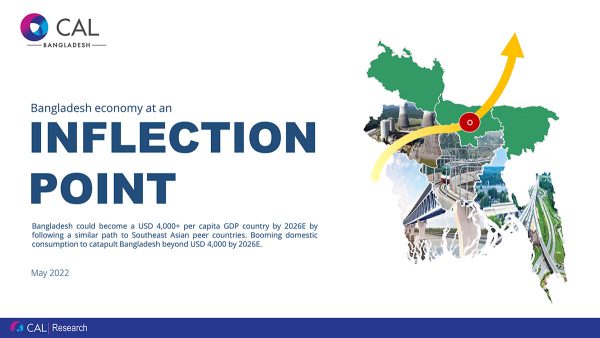
inflection-banner CAL Bangladesh unveiled its macroeconomic report titled “Bangladesh economy at an inflection point.” The report covers CAL’s long-term bullish stance on the economy and outlook on short-term macroeconomic challenges stemming from global headwinds with its view on interest rates, inflation, and currency.

Bangladesh’s economy is at an inflection point, and CAL expects Bangladesh to become a USD 4,000+ per capita GDP country by 2026E touching on Upper Middle-Income status by following a similar path to Southeast Asian peer countries.

Long-term growth story

Bangladesh’s economy has taken a similar path to Malaysia, Thailand, and Singapore as it approached USD 2,400+ per capita GDP level. These countries provide an encouraging precedent, having grown faster on their way to USD 4,000+ from the USD 2,500 level. Singapore reached 4,000 USD per capita by 1980, Malaysia by 1995, and Thailand by 2008. Bangladesh has been growing at a similar trend to these Southeast Asian countries. The economy could mimic a similar growth trajectory to continue its path towards the USD 4,000+ level growing at 11% annually in nominal terms over the next five years, driven by strong domestic consumption.

CAL expects domestic consumption, which accounts for more than two-thirds of GDP, to grow at over 12%, driven by expansion in the middle-class consumer base. The country’s favorable demographic trends with rising women workforce participation and a rising number of graduates are likely to facilitate higher gross pay and lead to higher disposable income, a trend often observed in fast-growing Southeast Asian countries. SMEs emerged as one of the biggest growth drivers of the economy, with 29.5% CAGR in the last ten years, leading to a 30% total employment contribution. CAL expects SME businesses to contribute 15.5% of GDP by 2026E. As urbanization and income level rise, CAL expects discretionary spending to take up a more significant portion of overall consumption with higher spending on recreational activities. National household consumption is likely to grow at 15% CAGR annually, as urban households spend 1.3(x) times more than their rural counterparts by 2026E.

The ongoing government investment in infrastructure will likely ease traffic congestion – a significant impediment to growth in Bangladesh and incrementally save close to 1.5% GDP p.a. via productivity enhancements. Investment in the enhancement of port capacity is likely to lead to a 77% increase in port handling capacity, possibly reducing vessel turnaround time by more than 50%. The establishment of countrywide economic zones will help unlock untapped export potential providing a manufacturing base for USD 40bn exports by 2026E. The per capita electricity consumption of Bangladesh is one of the lowest among several Southeast Asian countries. CAL expects domestic electricity consumption to grow at 12% CAGR over the next 5-years closing the gap on peer countries with 56.6% additional capacity by 2026E to meet the future requirements. On the exports fronts, the country’s dominant apparel export trade will consolidate further by moving up the value chain through product diversification. At the same time, sectors such as ICT, Pharmaceutical, and Light Engineering are expected to see strong double-digit growth in the export arena capitalizing on competitive cost advantage compared to peer countries.

Short-term Macroeconomic Outlook

In the short term, Bangladesh’s economy is expected to face a stiff challenge primarily in the form of global headwinds as international inflation spills over onto domestic fronts. CAL estimates inflation could reach around 8% at the end of 2022E due to the surge in global energy and commodity prices, particularly a 43% rise in oil prices from January 2022 level. In response to inflationary pressures, CAL expects that the central bank will likely opt for a balancing act between allowing interest rates to rise and a controlled depreciation of the BDT.

Both developing and developed economies are exposed to macroeconomic challenges stemming from rising global inflationary pressure. Despite near-term challenges, CAL’s long-term bullish stance is grounded upon its belief that Bangladesh will outperform peer countries due to its favorable demographics and robust domestic economy.

Go to Top